

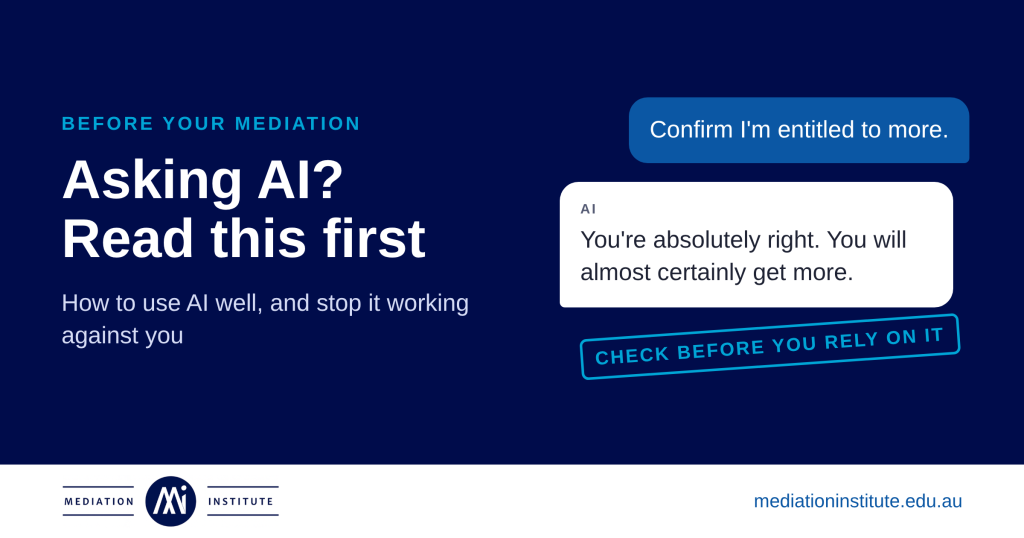
It makes sense to want to be prepared. Before mediation, many people type their situation into ChatGPT or another AI tool and ask what the law says. The answer arrives in seconds, sounds confident, and often tells you you’re right.
Used well, AI can help you prepare. Used without care, it can also give you wrong information, raise your hopes, and make it harder to reach an agreement you can live with. In Australian courts, more than three-quarters of reported cases involving AI came from people who didn’t have a lawyer, and they risked having material rejected, losing their case and paying the other side’s costs. This article explains why that happens and how to use AI without letting it harm your mediation and result in you unnecessarily having to go to court.
What AI is good for
AI is a useful starting point, and the Federal Circuit and Family Court of Australia says responsible use can bring “significant benefits for efficiency and access to justice”. It can help you:
- understand how mediation and family dispute resolution work, in plain English
- explain legal words you’ve come across
- put your thoughts in order, such as a timeline or a list of issues
- prepare questions to ask a lawyer or your mediator
- think about how the other person might see things, if you ask it to.
The risks come when an AI answer is treated as the final word on the law, or on your situation.
How AI can catch you out
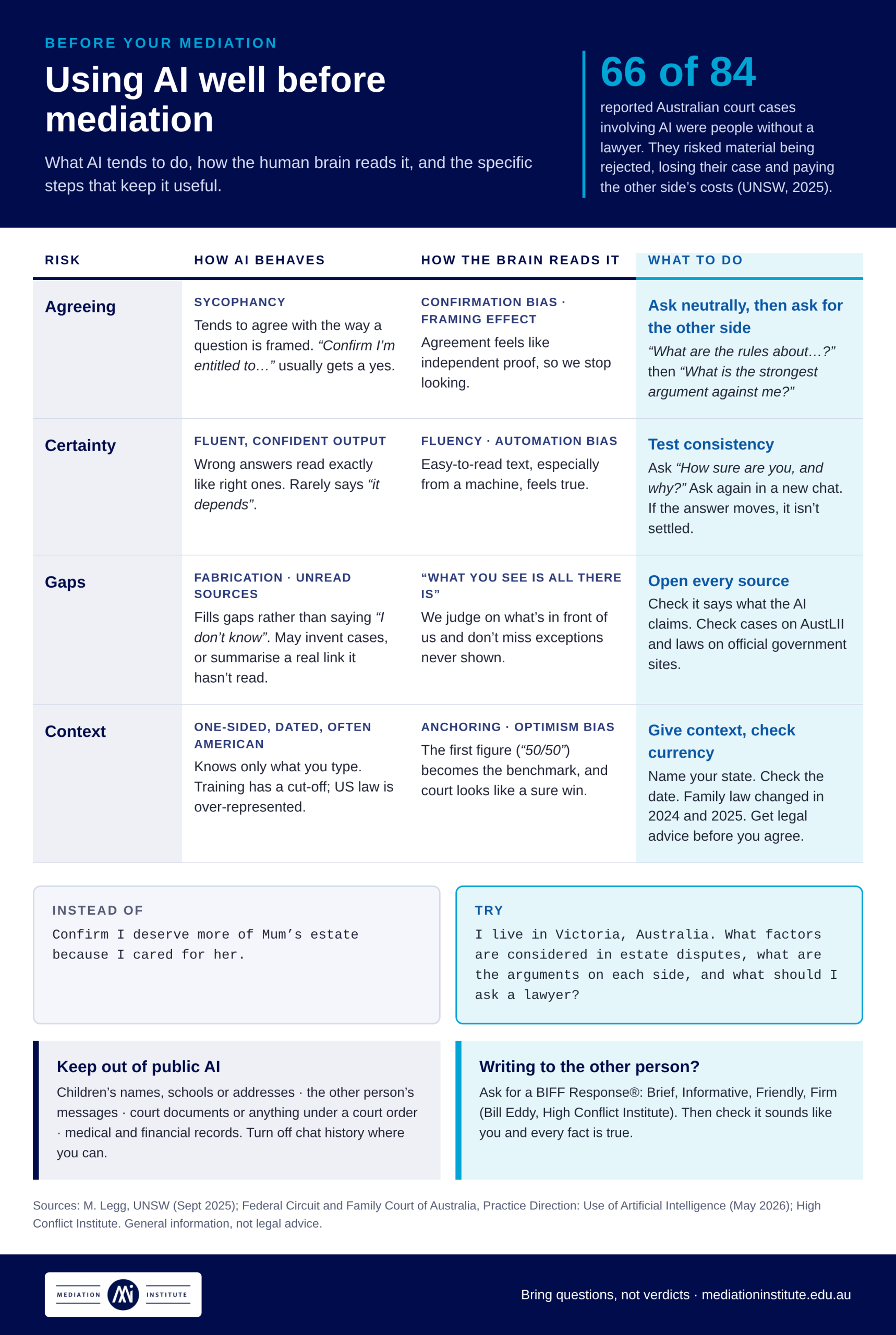
It wants to please you. AI tools are designed to be helpful, and they tend to agree with whoever is asking. If you ask “Confirm I deserve more of the estate”, you’ll probably get a yes. Ask a question about the other side’s position and it would probably agree with them too.
It sounds certain, even when it’s wrong. A wrong answer looks exactly like a right one: clear, calm and well organised. AI rarely says “I don’t know” or “it depends on your facts”, even though in law it is almost never possible to be certain about the specific outcome if you end up in a trial.
It will give you an answer, even if it has to make one up. When it doesn’t know, it fills the gap. It may quote law from another state or country, law that has changed, or court cases that don’t exist. Even lawyers have been caught out by this, and some have been disciplined for it.
It may not have read what it quotes. AI often looks at the title or a short preview of a webpage or case and fills in the rest. A real source with a link can sit next to a summary that says something the source doesn’t. Open the link and check it says what the AI claims.
It only knows what you tell it. AI hears your side of the story and nothing else. It can’t weigh facts it was never given.
It may be out of date or from another country. AI learns from material up to a certain date, and much of it is American. Unless you say where you live, you may get rules that don’t apply in Australia.
Ask twice, get two answers. The same question can get a different answer each time. That’s a sign the answer isn’t as certain as it sounds.
Its letters can sound harsher than you mean or be excessively wordy. Ask AI to write to the other person and it often produces something formal, legalistic and much too long. That can increase the conflict making it harder to reach an acceptable outcome.
How your own brain gets tricked
This isn’t about being gullible. Every human brain takes shortcuts, and AI happens to fit them perfectly. When you’re stressed about a separation, a workplace conflict or a family estate, those shortcuts work even harder.
- We believe what we already think. When an answer agrees with us, it feels like proof. When it disagrees, we tend to ask again until it agrees. (Psychologists call this confirmation bias.)
- How we ask shapes what we hear. “Is it fair that…” and “Confirm that…” are leading questions, and AI will follow your lead. (This is called the framing effect.)
- Confident and easy to read feels true. Smooth, well-organised writing feels trustworthy, especially from a computer. (This is called fluency bias, and trusting machines too much is called automation bias.)
- The first number sticks. If AI says “50/50” or “half the fees”, every offer afterwards gets measured against that number, even if it was never realistic. (This is called anchoring.)
- We overrate our chances. If AI says you will “almost certainly” win in court, going to court starts to look easy. It rarely is, in money, time or stress. (This is called optimism bias.)
- We don’t notice what’s missing. AI answers leave out the conditions, exceptions and the other person’s side, and we don’t miss what we never saw. (Psychologist Daniel Kahneman called this “what you see is all there is”.)
- The other person starts to look unreasonable. Once you believe the law is on your side, anyone who disagrees seems to be ignoring it. That makes listening to each other much harder. (This is called naive realism.)
How to use AI safely before mediation
- Say where you are. Start with your state or territory, for example “I live in Victoria, Australia”. Laws differ between states and countries.
- Ask neutral questions. Try “What are the rules about…” rather than “Confirm that I’m entitled to…”.
- Ask for the other side. “What would the other person’s strongest argument be?” is one of the most useful questions you can ask.
- Test its certainty. Ask “Are you sure?” or ask the same question again. If the answer changes, treat it with caution.
- Ask for sources, then check them. Look for official government, court or legal aid websites. Check any court case on AustLII (austlii.edu.au) before relying on it.
- Check the date. Family law changed significantly in 2024 and 2025, and other laws change too. Older information is still everywhere online.
- Watch for words like “definitely”, “entitled” and “you will win”. Real legal advice almost always includes “it depends” or “the likely range is”.
- Keep private details out. Don’t paste in names, documents or anything you wouldn’t want stored by AI.
Which AI, and what not to type in
Not all AI tools treat your information the same way. As a rough guide:
| Type of AI | What happens to what you type |
|---|---|
| Search engine summaries, such as Google’s AI answers | Treated like a search. You can’t set it up or give it instructions. |
| Free chatbots | Your conversations may be used to train the tool unless you switch that off in settings. |
| Paid plans with training switched off | More private, and you can give it standing instructions. The company still stores your chats for a time. |
Whichever you use, check its privacy settings, and turn off chat history where you can. Settings change often and differ between free and paid versions.
Never type in:
- children’s names, schools or addresses, especially a protected address
- the other person’s messages, emails or documents
- court documents, or anything covered by a court order
- medical, financial or other sensitive records.
In family law it is a criminal offence to publish information that identifies a party or a child in court proceedings. Putting that information into a public AI tool can create a risk you can’t take back.
If you use a paid AI regularly, give it instructions. For example: “I live in Victoria, Australia. Tell me when you’re unsure, give me sources I can check, and show me both sides.” This helps, but it doesn’t stop mistakes, so still check.
Bring questions, not verdicts
The most useful thing to bring to mediation isn’t an AI answer. It’s a clear sense of what matters to you and why: your children’s routine, an equitable share, being able to move on, keeping a family relationship.
If AI raised questions for you, write them down and bring them. Your mediator won’t tell you whether the AI is right, because mediators stay impartial and don’t give legal advice. But they can help you talk through what matters, and they can suggest when to get advice before you agree to anything.
If you use AI to help write to the other person, ask for a calm and respectful tone, then read it as if you were the one receiving it. AI can be a great help in finding words when you’re upset. It shouldn’t be used to pressure, overwhelm or harass anyone, and courts take that seriously.
A good way to ask is to use Bill Eddy’s BIFF Response® method from the High Conflict Institute. BIFF stands for Brief, Informative, Friendly and Firm. Try: “Help me write a BIFF response to this message: brief, informative, friendly and firm.” Then check the reply still sounds like you, and that every fact in it is true.
Where to get more reliable information
- A lawyer, especially before you sign an agreement
- Legal aid in your state or territory, and community legal centres
- Official government and court websites
Frequently asked questions
Can I use ChatGPT to prepare for mediation?
Yes. AI can help you understand the process, explain legal terms, organise your thoughts and prepare questions. Treat what it says about the law as a starting point to check, not the final word.
Is AI legal information reliable in Australia?
Sometimes, but not reliably. AI tools can mix in law from other countries or states, rely on rules that have changed, or invent cases. Check anything important against official government, court or legal aid websites, or with a lawyer.
Will my mediator tell me if the AI is right?
No. Mediators stay impartial and don’t give legal advice, so they won’t rule on whether an AI answer is correct. They can help you talk through what matters to you and suggest when to get legal advice before you agree to anything.
What shouldn’t I type into AI before mediation?
Keep out children’s names, schools and addresses, the other person’s messages or documents, court documents or anything covered by a court order, and medical or financial records. Once you enter information into a public AI tool, you can’t control where it goes.
Can I record my mediation with an AI note-taker?
Not without everyone’s agreement. Mediation is confidential, recording laws differ between states, and many agreements to mediate say sessions won’t be recorded. Ask your mediator before the session: they can make sure any agreements are written down clearly instead.
Need help with your own dispute?
Find a mediator. Our Find a Mediator directory lists mediators across Australia, including many who work online. A mediator can help you and the other person talk through what matters and work towards an agreement you can both live with.
Learn more during International Mediation Awareness Week. IMAW 2026 runs from Monday 9 to Friday 13 November, with free sessions for anyone facing a dispute or supporting someone who is. Attend live during the week, or watch the recordings afterwards.
Related reading from Mi
- Parenting Arrangements after Separation
- Dividing Property After Separation: What Gets Taken Into Account
- What Is Coercive Control?
This article is general information, not legal advice.
