
AMDRAS COT Alternative Pathway
If you have completed substantial mediation training outside an AMDRAS Recognised Certificate of Training (COT), you may be eligible to apply for formal recognition through the AMDRAS COT Alternative Pathway.
There are two protocols: the Standard COT Alternative Pathway and the FDR Practitioners Alternative Pathway.
The Alternative Pathway is designed to recognise equivalent training and experience without requiring unnecessary duplication, while maintaining consistent national competency standards.

At a glance
Which pathway applies to you?
The two protocols cross over in places. This flow chart can help you identify which pathway is likely to apply to your circumstances.
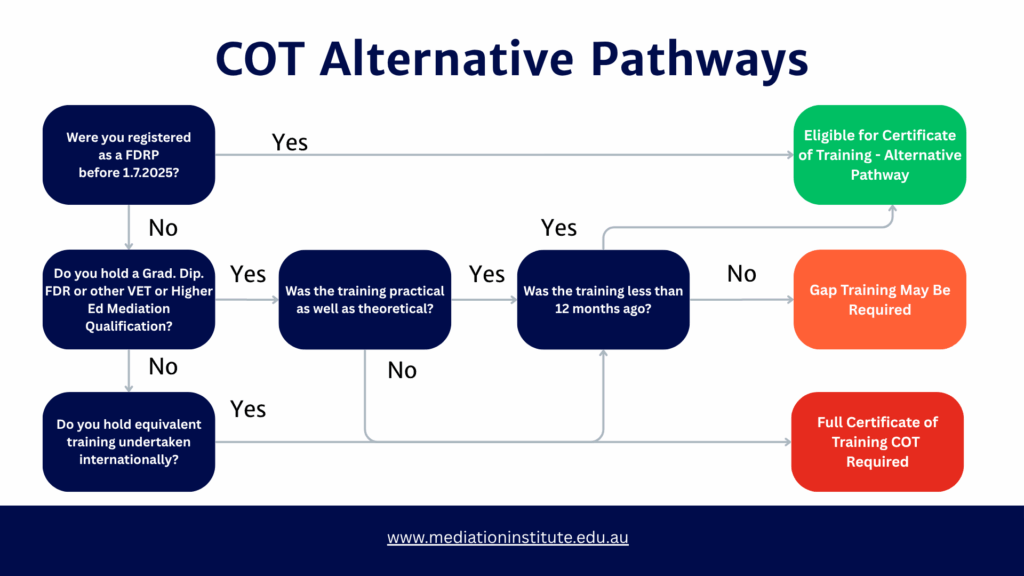
Two Alternative Pathways
Standard COT Alternative Pathway
For applicants seeking equivalence recognition for prior mediation training (including international training, or training through universities or VET providers that are not delivered as an AMDRAS recognised COT).
Your training should demonstrate
- Comparable duration and intensity to AMDRAS approved programs
- Strong practical components, including supervised simulated mediations
- Trainers with relevant mediation qualifications and experience
- Alignment with AMDRAS core competency framework
FDR Practitioners Alternative Pathway
Introduced to streamline accreditation for Family Dispute Resolution Practitioners (FDRPs) and relevant graduates whose training was not delivered under an AMDRAS recognised COT program.
Who is eligible
- Current FDRPs registered with the Attorney-General’s Department
- FDR qualified graduates who are not yet registered, or who registered after 1 July 2025
- Applicants able to provide evidence of qualifications, registration date, and practice
Note: FDRPs obtaining COT via this pathway are expected to progress to the Certificate of Assessment (COA).
How to apply
The application process is designed to be evidence-based and transparent. You can work offline first, or submit online.
Prepare your evidence
Collect course outlines, certificates, assessment information, trainer details, and practical component evidence. If applying under the FDR pathway, include your registration date and relevant practice evidence.
Submit your application
Submit your evidence to Mediation Institute for review under the relevant Alternative Pathway protocol.
Receive an outcome
Outcomes may include approval (COT issued via pathway), a request for targeted gap training, or not approved if criteria are not met.
Forms and links
Possible outcomes
Approved
Your application is approved and a COT is issued, noting it was granted via the Alternative Pathway.
Gap training required
If certain elements are missing or outdated, you may be required to complete refresher training, supervised simulations, or targeted assessment aligned with AMDRAS standards.
Not approved
If the evidence does not meet the criteria, the application may not be approved. In many cases, the AMDRAS recognised COT is the most appropriate pathway.
After COT approval
Once a COT is issued (including via the Alternative Pathway), the usual next step is the AMDRAS Certificate of Assessment (COA).

Examples and guidance
The case studies below illustrate common scenarios and how they are typically viewed against the AMDRAS requirements.
Case study: Short online conflict course without live practice
Case study: Workplace coaching or leadership certificate
Case study: Restorative justice workshop
Case study: University theory-only unit
Case study: Australian mediation course with accredited trainers but non-recognised provider
Frequently Asked Questions
What is the purpose of the COT Alternative Pathway?
What evidence should I include?
What happens if some elements are missing?
What is the next step after COT approval?
Ready to begin?
Start by downloading the evidence collection form, or apply online if your documents are ready.
