
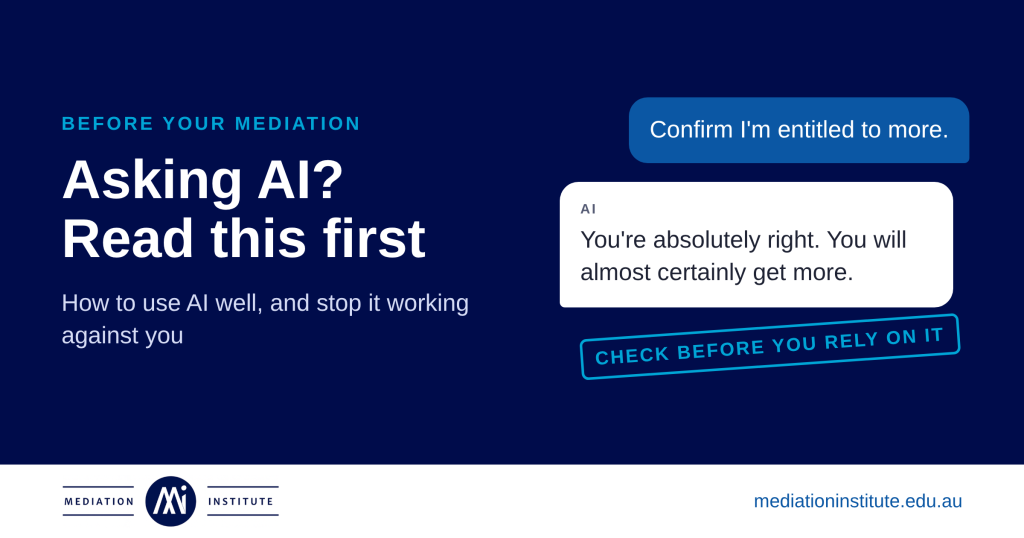
Asking AI Before Mediation? Read This First
Asking ChatGPT about your situation before mediation? AI can help you prepare, but it can also please you, sound certain when it’s wrong, and make things up. Here’s how to use it well.

Asking ChatGPT about your situation before mediation? AI can help you prepare, but it can also please you, sound certain when it’s wrong, and make things up. Here’s how to use it well.

When a party brings an AI answer to mediation and expects it to settle the dispute, what should you do? How AI misleads, the biases it feeds, what mediation theory offers, and the confidentiality risks of AI note-takers.
Bullying, harassment and reasonable management action are three different things in law, with different tests, different bodies hearing them and different answers to whether mediation is the right tool. How to tell them apart, including when the behaviour runs sideways between colleagues or upwards at a manager, and what happens when the complaint itself becomes the target.
Bullying, Harassment or Reasonable Management Action? Telling Them Apart at Work Read More »
Coercive control leaves no bruises but is now a crime in parts of Australia. What it looks like, what the law says, and what it means for family mediation.
What Is Coercive Control? How You Can End Up in Jail Without Raising a Hand Read More »
NSW and Queensland have criminalised coercive control; Victoria and South Australia have passed laws not yet in force. The four offences compared side by side, and what they mean for FDR practitioners, mediators and lawyers.
No, you don’t need a law degree to become a mediator in Australia. We clear up 7 common myths about mediation training, AMDRAS accreditation, FDR pathways and what the work really looks like.
Do You Need to Be a Lawyer to Be a Mediator? 7 Myths About Mediation Training Read More »