

The phone across the table
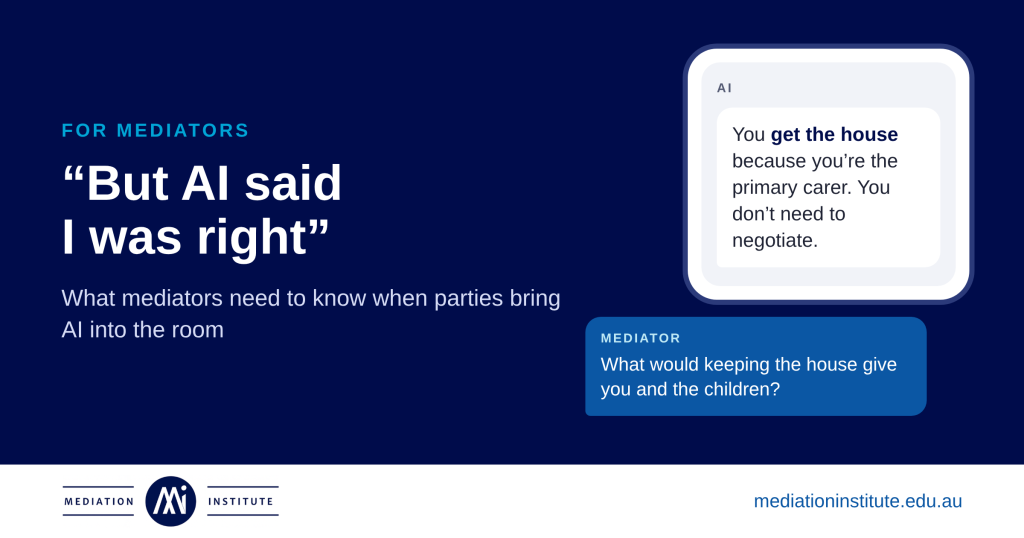
Twenty minutes into a mediation, a party slides their phone across the table. “ChatGPT says I get the house because I’m the primary carer. So we can skip all this.”
More and more mediators are having this moment. Professor Michael Legg of UNSW found 84 reported Australian court cases involving generative AI between late 2022 and September 2025, and 66 of them involved people without a lawyer. We couldn’t find research on mediation specifically, but these are the same people who come to mediation. AI in mediation is now an everyday reality.
The AI answer may be right, partly right or completely made up. Our job is not to work that out. Our job is to keep the conversation moving, keep our impartiality, and make sure people sort through their priorities.
Where AI helps
This isn’t a case against AI. Used well, it helps parties understand the process, learn the vocabulary, organise their thoughts and arrive with better questions. That can mean better-prepared, more confident participants.
The Federal Circuit and Family Court’s Practice Direction on AI, issued in May 2026, makes the same point. It says responsible use “can have significant benefits for efficiency and access to justice”. It even suggests a party with good AI tools should offer to help the other side, for example by drafting a joint chronology. That’s a collaborative idea mediators can work with.
The risks sit in how AI is built and how our brains read it. Knowing both lets us respond without dismissing the person or the tool.
Why AI legal answers go wrong in mediation
General AI tools like ChatGPT are built to be helpful. In legal questions, three habits make that helpfulness risky.
- It wants to please. AI tools tend to agree with the person asking. Ask “Confirm I deserve more of Mum’s estate” and you will usually get a yes. Researchers call this sycophancy.
- It sounds certain when it shouldn’t. Wrong answers arrive in the same calm, well-formatted sentences as right ones. There is rarely an “I’m not sure”.
- It will always give an answer, even if it has to make one up. If it doesn’t know, it fills the gap: law from another state or country, law that has since changed, or cases that don’t exist.
Some other structural features matter in mediation too:
- It only hears one side. AI works from one party’s account, with its gaps and its spin.
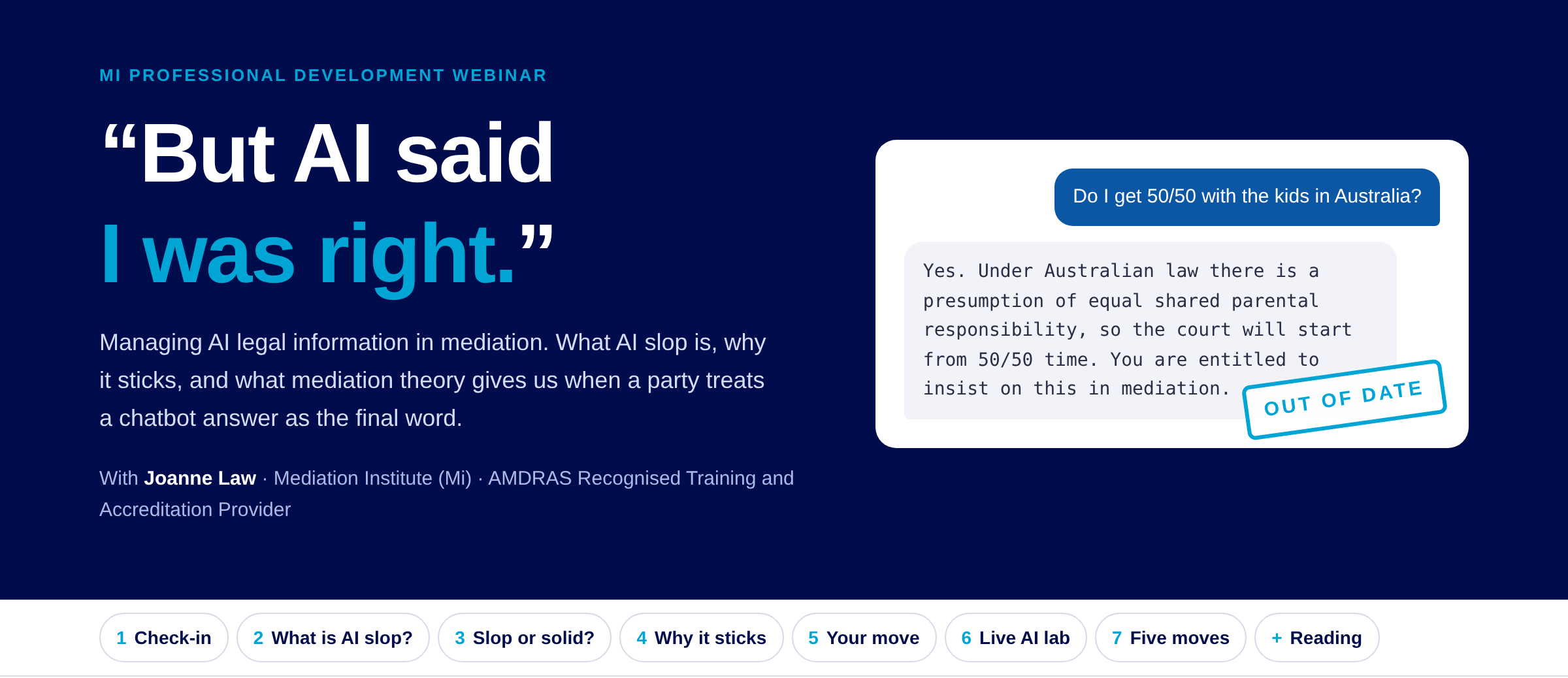
- It can be out of date. It learns from material up to a cut-off date, and older web content often outweighs newer. That’s why the pre-2024 family law position still turns up.
- It defaults to American law. Expect “custody” and “attorney” unless the person names their state.
- Ask twice, get two answers. Answers vary between attempts, which shows how unsettled they can be.
- Its writing escalates. AI-drafted letters and opening statements often come out formal, legalistic and more aggressive than the person intends.
- It can carry bias. Answers can reflect stereotypes in the material it learnt from, for example about mothers and fathers.
- It may not have read what it cites. AI often works from a source’s title or a short preview and fills in the rest, so a real link can sit beside a summary the source doesn’t support. In preparing this article, the AI we used did exactly this with a regulator’s statement until we checked it. Clients don’t always check beyond the URL showing a reputable source.
Lawyers are not immune. In Dayal [2024] FedCFamC2F 1166, a Victorian lawyer gave the Federal Circuit and Family Court a list and summary of cases generated by AI that turned out to be inaccurate. In 2025 the Victorian Legal Services Board restricted his practising certificate.
The human side: biases AI feeds
The AI is only half the problem. The other half is the human brain reading the answer. AI’s habits line up neatly with biases and thinking shortcuts we all have.
| Human bias | What it means | How AI feeds it | What you see in mediation |
|---|---|---|---|
| Confirmation bias | We look for and believe information that supports what we already think | AI agrees with how the question was asked | “Even the computer agrees with me” |
| Framing effect | How a question is worded shapes the answer we get | Leading questions get leading answers | A party who asked “Confirm I’m right” |
| Authority and automation bias | We over-trust confident sources and machines | Fluent, formatted, certain answers | Printouts treated as the final word |
| Fluency bias | Information that is easy to read feels more true | Smooth, plain-English answers | Little interest in checking |
| Anchoring | The first number or rule we hear becomes our reference point | Gives a figure early (“50/50”, “half the fees”) | Every offer judged against the AI’s number |
| Optimism bias and an inflated BATNA | We overrate our chances | Promises outcomes (“almost certainly”, “you will win”) | Walking away to court looks like a sure win |
| “What you see is all there is” | We judge on what’s in front of us and don’t notice what’s missing | Leaves out conditions, exceptions and the other side’s view | Surprise when the facts don’t fit the printout |
| Naive realism | We believe we see things as they really are, so people who disagree must be unreasonable | Hands a party an “objective” view that matches their own | The other party is seen as ignoring the law |
| Escalation of commitment | The more we invest in a view, the harder it is to let go | Hours of research build a case | Digging in, especially in joint session |
The last two matter most for us. Once a party believes the law is on their side, the other party stops looking like someone with a different view. They start looking like someone who is wrong.
What mediation theory tells us to do
The good news is that we already have the tools. None of them require us to know whether the AI is right.
- Positions and interests (Fisher and Ury). Principled negotiation asks us to separate the people from the problem, focus on interests not positions, invent options for mutual gain, and use objective criteria. An AI printout is a position with a citation attached. Ask what that outcome would give them, and you are back to interests. It can also pose as an objective criterion, but a criterion is only objective if both parties accept it. An official guide the parties read together does that job far better than one party’s chatbot.
- Reality testing the BATNA. A party’s BATNA, their best alternative to a negotiated agreement, sets the point at which they’ll walk away. Its partner is the WATNA, the worst alternative, and somewhere between sits the most likely outcome. Sycophantic answers inflate the BATNA and hide the WATNA, so court starts to look like a safe bet. Reality-test all three, including cost, time, stress and the effect on relationships, ideally in private session where a party can think aloud without losing face.
- Narrative mediation (Winslade and Monk). Parties often arrive with a conflict-saturated story in which they are right and the other person is the problem. Narrative mediators work to externalise the conflict, separating it from the people, and to build an alternative story from moments the dominant story leaves out. The AI answer joins the dominant story and seems to seal it with authority. Externalise the AI’s version too: “So the AI’s version says… What parts of your story does it leave out?” Then look for the exceptions, such as times the parties have co-operated well.
- Transformative mediation (Bush and Folger). Bush and Folger see conflict as a crisis in how people interact: people feel weaker and more self-absorbed. The mediator’s job is to support two shifts. Empowerment is a party regaining clarity, confidence and the capacity to decide for themselves. Recognition is a party becoming more open to the other person’s perspective. An AI printout often sits on the empowerment side: bringing research is an attempt to feel competent and be taken seriously, so acknowledge it and help the party test and own their thinking rather than outsource it. But a one-sided AI answer can block recognition by making the other person’s view look simply wrong. Invite it back: “What do you think matters most to them?”
- Procedural justice (Lind and Tyler). People accept outcomes more readily when the process feels fair, and four things drive that: voice (being able to tell their side), neutrality, respectful treatment, and trust in the decision-maker’s motives. A party who brings AI research is often claiming voice. Dismissing the research can feel like dismissing them, and so can taking it too seriously against the other party. Give it a hearing, treat both parties’ sources the same way, and explain how the process will deal with legal questions, which is taking the time to get real legal advice.
- Impartiality. The pull is to rule on whether the AI is right. Riskin’s grid separates facilitative mediators, who help the parties reach their own assessment, from evaluative ones, who give a view on likely outcomes. Ruling on an AI printout moves us firmly towards evaluation, and possibly into legal advice, and the party whose AI “loses” will see us as taking sides. Stay out of the referee’s chair. General information about process is fine; an opinion on whether this party’s legal claim is right belongs with their lawyer.
One exception: when an AI answer minimises family violence or controlling behaviour, it is not a position to reframe. It is a screening flag, and safety comes before process.
Risks for us as mediators
Many of us now use AI ourselves, to draft agreements, summarise notes or prepare for sessions. It can save real time. It also brings its own risks.
Confidentiality. What goes into an AI tool may be stored, and with some tools used for training. Mediation confidentiality, and in FDR the obligations under the Family Law Act, don’t stop at the door of a chatbot. The court’s Practice Direction separates “public AI” from “closed AI” and says not to put confidential or sensitive information into public tools. The American Bar Association’s Formal Opinion 512 (July 2024) goes further for lawyers: tools that learn from what you type need the client’s informed consent before client information goes in, and boilerplate terms aren’t enough.
| Type of AI | Learns from what you type? | Standing instructions? | Client information? |
|---|---|---|---|
| Search engine summaries (e.g. Google’s AI answers) | Treated as search queries | No | No |
| Free chatbots | Often yes by default, unless switched off | Sometimes | No |
| Paid personal plans with training switched off | No, but chats are still stored for a time | Yes | Only de-identified, and with care |
| Business or enterprise plans with contract terms | No, under contract | Yes, and an administrator can set rules | Closest to “closed AI”: check the terms |
| Open-source models run on your own computer | No, information stays local | Yes | Strongest for privacy, but needs setup and may be less accurate |
Settings and terms change often and differ between tiers, so check the tool you actually use. Paying for a tool doesn’t make it accurate.
Accuracy. An AI-drafted agreement or summary is our document once we use it. Check every clause.
AI as a tool of conflict or control. The Practice Direction says AI must not be used to commit family violence or “litigation abuse”: harassing, overwhelming or improperly burdening the other party. Floods of AI-written messages or documents may be part of a pattern worth screening for.
A gap in guidance. As at October 2026, we could find no guidance on AI from AMDRAS or from the Attorney-General’s Department for FDR practitioners. The FCFCOA’s Practice Direction is the closest official Australian guidance, and it is worth every mediator reading.
AI note-takers and transcripts: start with “why?”
Mediators often ask us whether they should use an AI tool to record and transcribe client meetings or mediation sessions. The first question is what a transcript would give you that your own brief notes don’t. A transcript captures everything: offers, admissions, emotional disclosures and things said in private session. That is more to protect, more to explain, and more that someone may later ask for.
If you are still considering it, work through four questions.
1. Is the recording lawful? Recording laws differ between states. In Victoria, Queensland and the Northern Territory a person taking part in a private conversation can generally record it without everyone’s consent. In New South Wales, South Australia, Western Australia, Tasmania and the ACT the general rule is that everyone must consent. Even where recording is allowed, laws can restrict sharing the recording. Online sessions often cross state lines, so the safe course is everyone’s informed consent, every time.
2. What happens to confidentiality? In family dispute resolution, section 10H of the Family Law Act stops the practitioner disclosing what is said in FDR except in limited situations, and section 10J makes most of it inadmissible in court. A transcript is a written record of exactly those communications, and sending audio to an AI company’s servers adds a third party to the process. How these sections apply to AI transcription has not been tested, so get advice before relying on it. Outside FDR, confidentiality rests largely on the agreement to mediate. Many agreements say sessions will not be recorded. Are you breaching your own agreement?
3. Have the parties consented, and could they say no? The Office of the Australian Information Commissioner (OAIC) says consent should be sought as best practice for AI note-takers. It also says consent cannot be implied just because someone was told. Informed consent means telling parties which tool, where the data is stored, who can access it, how long it is kept, whether it is used for training, and that saying no will not affect their mediation. The American Bar Association reached a similar view for lawyers in Formal Opinion 512: tools that learn from what is entered need informed client consent, and boilerplate terms are not enough. Do you even know the answers to where the data is stored, who can access it, how long it is kept and whether it is used for training the AI tool?
4. What if a party asks for a copy? Decide this before you create anything. A transcript contains both parties’ personal information, so giving it to one party discloses the other’s words. If your practice is covered by the Privacy Act, people can generally ask for access to their personal information. Many small businesses with turnover under $3 million are exempt, though not all (health service providers, for example), and the exemption is under review. Whatever applies to you, your agreement to mediate and privacy policy should say whether recordings are made and who, if anyone, receives them.
What about AI built into Microsoft 365? Copilot in a business Microsoft 365 account is much closer to the court’s “closed AI” than a free chatbot. Microsoft says prompts, responses and your organisation’s data aren’t used to train its AI models, that it acts as a data processor under its business terms, and that data for Australian business accounts is stored at rest in Australia. A personal or family Microsoft 365 plan runs under consumer terms, so check its settings separately. Three things don’t change, though:
- The record still exists. Teams stores meeting recordings and transcripts in OneDrive or SharePoint, and Copilot keeps a history of prompts and responses. Both are retained under your settings and can be searched for legal discovery.
- The defaults may save more than you expect. Copilot in Teams meetings needs a transcript, and in Microsoft’s default setting that transcript is saved. Options exist for temporary transcripts, or a summary without any transcript, but someone has to choose them.
- Consent and recording laws still apply. Good security doesn’t replace the parties’ informed consent, or your agreement to mediate.
A sensible default. Don’t record or transcribe pre-mediation or mediation sessions with AI. Keep brief notes of your own. If you use AI to help write up or draft, de-identify the material first and use a tool with training switched off. If you do decide to use an AI note-taker, use a closed business tool, get every participant’s written consent, update your agreement and privacy policy, and treat both parties equally on access. Treat any recording or transcript as part of your mediation records. In our reading, that means keeping and destroying it under the same rules the FDR Regulations and AMDRAS Standards set for other mediation records, which may mean holding it securely for years. Neither yet mentions AI recordings specifically.
Five moves when AI comes to the table
- Acknowledge the effort. “You’ve done some research on this.” People who feel heard can test their own views.
- Ask what it means to them. “What would that outcome give you and the children?”
- Stay out of the referee’s chair. Don’t confirm or correct the law. Your impartiality is one of the key benefits of mediation.
- Reality-test both ways. “What if a court saw it differently? What would that cost you, in money, time and family?”
- Point to checkable sources. Legal advice, community legal centres, official government guides, and AustLII for any case someone relies on.
A simple question helps with all five: “Where did you come across that?” Asked with curiosity, it shows how the party built their view, and how they asked the AI.
Keep exploring
AI isn’t going away, and our parties will keep using it. The mediators who do well will be the ones who treat an AI printout as a doorway into the conversation rather than a wall.
Watch the recording of But AI Said I Was Right: Managing AI legal information in mediation available in the Recorded Webinars for current members and try the interactive webinar page with its slop-or-solid cards and scenarios: AI said I was right interactive page
Want to practise using AI well? Mi’s own MiAi Mediation Coach and MiAi FDR Coach are built for mediators, students and FDR practitioners. They’re aligned with Australian standards and support role-plays, drafting and reflective practice. Like any AI, they give general information, not legal advice, so check what they tell you.
Related reading from Mi
- Bullying, Harassment or Reasonable Management Action? Telling Them Apart at Work
- Coercive Control Is Now a Crime in Four States: What Mediators, FDRPs and Lawyers Need to Know
- Parenting Arrangements after Separation
Information current at 29 October 2026. Next review: 29 April 2027, or sooner if AMDRAS, the Attorney-General’s Department or the FCFCOA issues new AI guidance.
Sources
- Michael Legg, More people are using AI in court, not a lawyer, UNSW, September 2025
- Victorian Legal Services Board, Statement on the Mr Dayal matter
- John Sturrock KC, Could AI Replace Mediators?, ADR Research Network, March 2026
- Katie Shonk, AI Mediation: Using AI to Help Mediate Disputes, Program on Negotiation, Harvard Law School, May 2026
- Federal Circuit and Family Court of Australia, Practice Direction: Use of Artificial Intelligence, 29 May 2026
- Wendy J. Muchman, Generative Artificial Intelligence Tools, The Bar Examiner, Fall 2024 (on ABA Formal Opinion 512)
- Office of the Australian Information Commissioner, Guidance on privacy and the use of commercially available AI products, October 2024, updated January 2025
- Hamilton Locke, Recording private conversations: the law in Australia, August 2025
- Microsoft Learn, Data, Privacy, and Security for Microsoft Copilot and Recommended configuration for Copilot: sensitive and regulated customers (Australia and New Zealand)
