
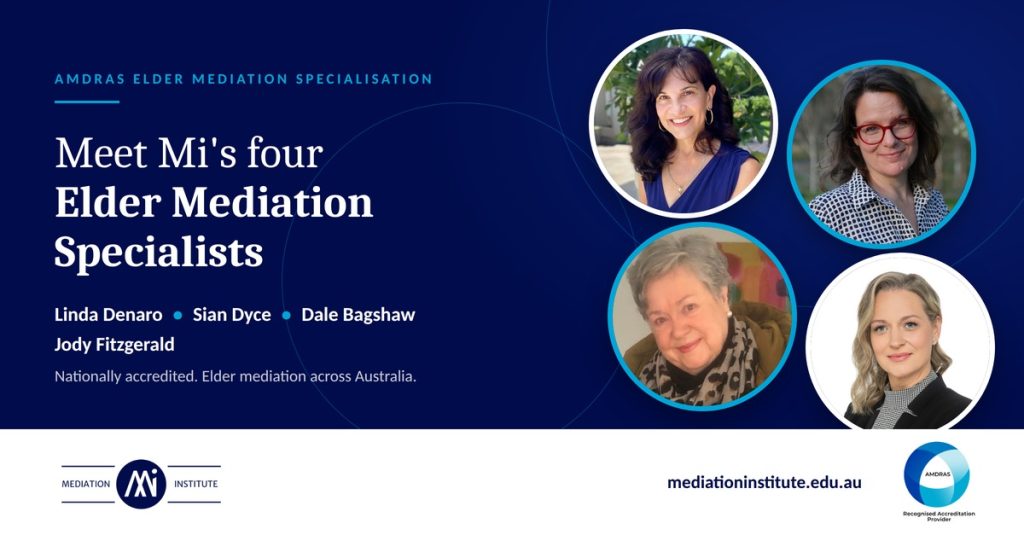
When ageing brings a family to a standstill — over care, money, the family home, or simply who gets to decide — a good mediator can help. An Elder Mediation Specialist is trained specifically for it.
AMDRAS recognised Elder Mediation as a specialist discipline in August 2025. Mi is an AMDRAS Recognised Accreditation Provider — one of the organisations AMDRAS authorises to grant national mediator accreditation and the specialisations that sit on top of it. Practitioners send us their evidence, we check it against the national standard, and we grant the accreditation. The elder mediation training itself is done elsewhere.
Four Mi Members now hold it: Linda Denaro, Sian Dyce, Professor Dale Bagshaw and Jody Fitzgerald. Linda and Sian offer online mediation, so families anywhere in Australia can work with them; Dale and Jody are based in South Australia.
Linda Denaro
AMDRAS Mediator, FDR Practitioner and Specialist Elder Mediator
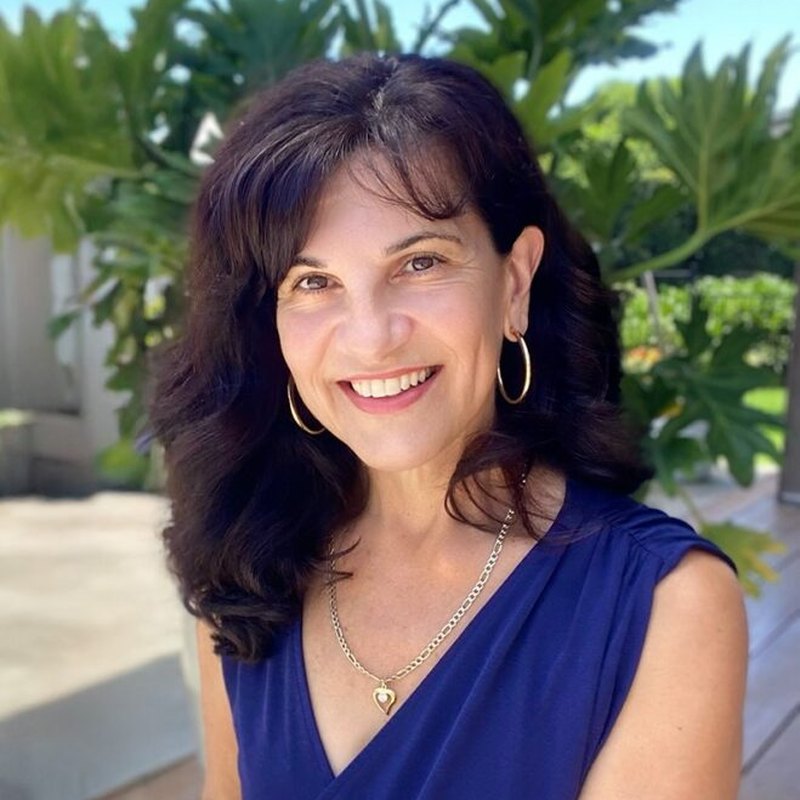
Linda has just been approved for the AMDRAS Elder Mediation specialisation, adding elder matters to a practice that already spans family dispute resolution and counselling.
She is an accredited Family Dispute Resolution Practitioner, a nationally accredited mediator, a registered counsellor, a Parenting Coordinator and a clinical supervisor. That combination suits families where the dispute in front of you is sitting on top of years of history.
Linda’s work covers parenting arrangements, property matters and parenting coordination, supporting parents, couples and families through separation, conflict and changing family circumstances. She brings a calm, caring and balanced approach — a structured, respectful process that helps people communicate more effectively, consider the wellbeing of those affected and make informed decisions about their future. Linda offers online mediation.
View Linda Denaro’s Mi profile
Sian Dyce
AMDRAS Mediator, FDR Practitioner and Specialist Elder Mediator — Family Talks

Sian is a certified Elder Mediator (EMIN, Advanced Certificate) and an accredited Family Dispute Resolution Practitioner who has helped more than one hundred families work through conflict and significant life change.
Her particular interest is families with adult children and ageing parents — the point where roles, care needs and expectations all shift at once. As she describes it, ageing tends to bring long-standing family dynamics to the surface, along with emotional challenges nobody saw coming.
Her practice leans heavily on preparation. Sian does thorough, supportive pre-mediation work with each party before anyone sits down together, which she finds is what makes the difference when emotions are running high.
Before mediation, Sian spent fourteen years in the media industry — first at The Chaser, then as a television news producer at the ABC. Earlier in her career she worked in community services and business administration, across urban and regional Australia and in the UK.
Professor Dale Bagshaw
AMDRAS Mediator, Specialist Elder Mediator and Chair of the Elder Mediation Australasian Network
Dale is the person most Australian elder mediators learned the work from. After 39 years as an academic she is now an adjunct Professor at Adelaide University, an AMDRAS accredited mediator, a Certified Elder Mediator (Advanced) with the Elder Mediation International Network (EMIN), Chair of the Elder Mediation Australasian Network (EMAN) and of the Resolution Institute’s Facilitative Elder Mediation Sub-committee, and a Fellow of the Resolution Institute.
For many years she was Director of the Centre for Peace, Conflict and Mediation at the University of South Australia and Program Director for its postgraduate mediation courses. Her research covers children of divorce, domestic and family violence, elder abuse, elder mediation and eldercaring coordination, and she has published widely and supervised numerous PhD students.
Dale sits on the EMIN Board and its Certification Committee, where she helped develop the international certification standards and Code of Ethics for elder mediators. She convened the first National Mediation Conference and the second International Mediation Conference, founded and chairs the Asia Pacific Mediation Forum, and in 2013 convened the 6th World Summit on Mediation with Age-Related Issues in Adelaide — and then founded EMAN.
Since the 1980s she has trained mediators in 11 countries, and since 2015 has delivered elder mediation training for trained mediators across Australia, New Zealand, Singapore and Hong Kong that counts towards EMIN certification and the AMDRAS specialisation. She has received two international and four national awards for her services to mediation and dispute resolution. Her next training intake runs in October and November 2026 — see How to become an Elder Mediation Specialist in Australia.
View Dale Bagshaw’s Mi profile
Jody Fitzgerald
AMDRAS Mediator, FDR Practitioner and Specialist Elder Mediator — Brightside Mediation
Jody brings a lawyer’s eye and a small-business owner’s practicality to elder mediation. She was admitted to legal practice in South Australia in 2002 and served as Associate to the Honourable Justice Nyland in the Supreme Court, and later worked as a political adviser to a Member of the Legislative Council in the South Australian Parliament, engaging with legislation and policy at a high level.
Alongside her Bachelor of Laws she holds a Bachelor of Commerce and has extensive hands-on experience running small businesses — a background that helps her understand and navigate disputes where money, property and family are tangled together, with a practical focus.
Jody is a nationally accredited mediator under AMDRAS and an accredited Family Dispute Resolution Practitioner. Her approach is grounded in practicality, empathy and strong interpersonal skills, creating a supportive environment for parties to find workable solutions to their disputes.
View Jody Fitzgerald’s Mi profile
What is elder mediation?
Elder mediation is a facilitated conversation about the decisions that come with ageing. Typical matters include:
- where an older person will live, and what care they need
- how the work and the cost of care are shared between adult children
- money, enduring powers of attorney and who makes financial decisions
- early inheritance, loans between family members and the future of the family home
- sibling conflict about who decides and who does the caring
- end-of-life wishes, and what happens afterwards
It is not the same as family dispute resolution after separation, and it is not the same as a commercial mediation. The dynamics are different enough that AMDRAS now recognises it as its own discipline.
What makes elder mediation a specialisation?
There are usually more than two people at the table. An elder mediation often involves the older person, several adult children, in-laws, and sometimes a carer, a health professional or an attorney appointed under an enduring power. Running a multi-party process well is a skill in its own right.
The older person is a party, not the subject. The most common failure in these conversations is that the family talks about Mum or Dad rather than with them. A specialist keeps the older person at the centre of decisions about their own life, and adapts the process — pace, breaks, support people, plain language — so they can genuinely take part.
Capacity, coercion and elder abuse. Specialists are trained to notice when someone is not able to make a decision freely, or is being pressured into one, and to know what to do about it. That screening is a large part of why the specialisation exists.
When should a family call an Elder Mediation Specialist?
It is worth making the call when:
- a decision about care or living arrangements keeps being deferred because the family cannot agree
- one sibling is carrying the load and resentment is building
- somebody is being left out of the conversation — including the older person
- money, the family home or an enduring power of attorney has become the flashpoint
- people have stopped speaking to each other, and a lawyer’s letter feels like the only option left
Mediation is voluntary, confidential and far cheaper and faster than a court application. It also leaves the family able to speak to each other afterwards, which matters more than usual when there is caring still to be done.
How to find an Elder Mediation Specialist
Use the Mi Find a Mediator directory and search the keyword elder mediation, or use the Request a Mediator button to be sent a shortlist of suitable practitioners. Linda and Sian offer online mediation, so location is not a barrier; Dale and Jody are based in South Australia.
Check the national register
If you are working with someone who says they are an Elder Mediator, check the AMDRAS national register: Elder Mediation specialists on the AMDRAS register.
If they are an AMDRAS mediator but do not hold the specialisation, that does not mean they cannot help you. The requirements are quite onerous, and they may be part way towards meeting them.
How does a mediator become an AMDRAS Elder Mediation Specialist?
To hold the specialisation a practitioner must already hold AMDRAS national accreditation as a mediator, hold Elder Mediation International Network (EMIN) certification at Cert.EM or Cert.EM (Advanced) level, carry professional indemnity insurance that covers elder mediation, and maintain membership of both EMIN and the Elder Mediation Australasian Network (EMAN).
Renewal every two years requires 20 hours of elder mediation practice (co-mediation counts) and 16 hours of CPD specific to elder mediation. Practitioners who hold it use the postnominal AMDRAS Specialist Dispute Resolution Practitioner (Elder Mediation).
Mi Members apply through mimembers.au. The full criteria and document list are set out in Are you eligible for the AMDRAS Elder Mediation Specialisation?
Thinking about it yourself? The training runs through Professor Dale Bagshaw (profiled above), with an intake in October and November 2026 and a $100 discount for Mi Members. See How to become an Elder Mediation Specialist in Australia.
Part of Mediation Explained.
Frequently asked questions
What is an Elder Mediation Specialist?
An Elder Mediation Specialist is a nationally accredited mediator who holds the AMDRAS Elder Mediation specialisation. They have completed additional certified training in elder mediation through the Elder Mediation International Network, hold insurance covering elder matters, and are assessed against national standards. Their postnominal is AMDRAS Specialist Dispute Resolution Practitioner (Elder Mediation).
Is elder mediation the same as family dispute resolution?
No. Family dispute resolution deals with parenting and property matters after separation and can issue a section 60I certificate. Elder mediation deals with decisions arising from ageing — care, living arrangements, finances, inheritance and end-of-life wishes — and usually involves more than two parties. Some practitioners, including Linda Denaro, Sian Dyce and Jody Fitzgerald, are qualified in both.
Can an older person take part if they have memory problems?
Often, yes. Reduced memory is not the same as losing the ability to make decisions. A specialist elder mediator will assess whether the person can take part, and adjust the process — shorter sessions, breaks, a support person, plain language, written summaries — so they can. If someone genuinely cannot make a particular decision, the mediator will say so rather than proceed.
Do we need lawyers for elder mediation?
Not to start. Many families mediate first and use a lawyer afterwards to document what they agreed, particularly where property, wills or an enduring power of attorney are involved. Anyone is free to get legal advice before, during or after mediation.
How do I check if a mediator really is an Elder Mediation Specialist?
Search the AMDRAS national register of mediators and filter by the Elder Mediation tag. If a mediator holds AMDRAS accreditation but not the specialisation, they may be part way towards meeting what are quite onerous requirements.
How do I find an elder mediator in Australia?
Search the Mediation Institute Find a Mediator directory at mimembers.au using the keyword “elder mediation”, or use the Request a Mediator form to be sent a shortlist. Several of Mi’s Elder Mediation Specialists offer online mediation anywhere in Australia.
What does elder mediation cost?
Fees are set by each practitioner and depend on the number of parties and the preparation required. It is substantially less than a contested court application. If cost is a barrier, Interact Support Inc offers means-tested low-cost mediation.